
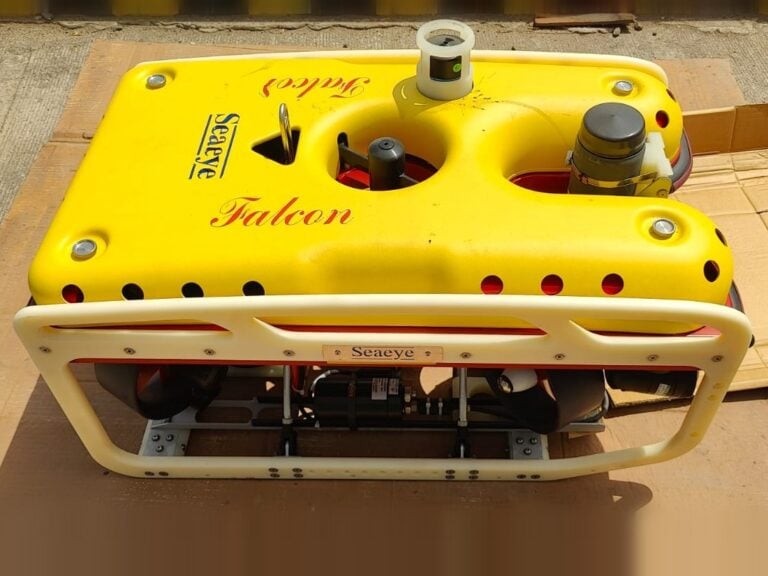
 Available
MR-102
Inspection Class · Saab Seaeye
Saab Seaeye Falcon
2011, unused, original crates
- Depth
- 300 m
- Year
- 2011
- Region
- Asia
Pricing after case-use fit check
USED ROVS · FALCON
 1 / 8
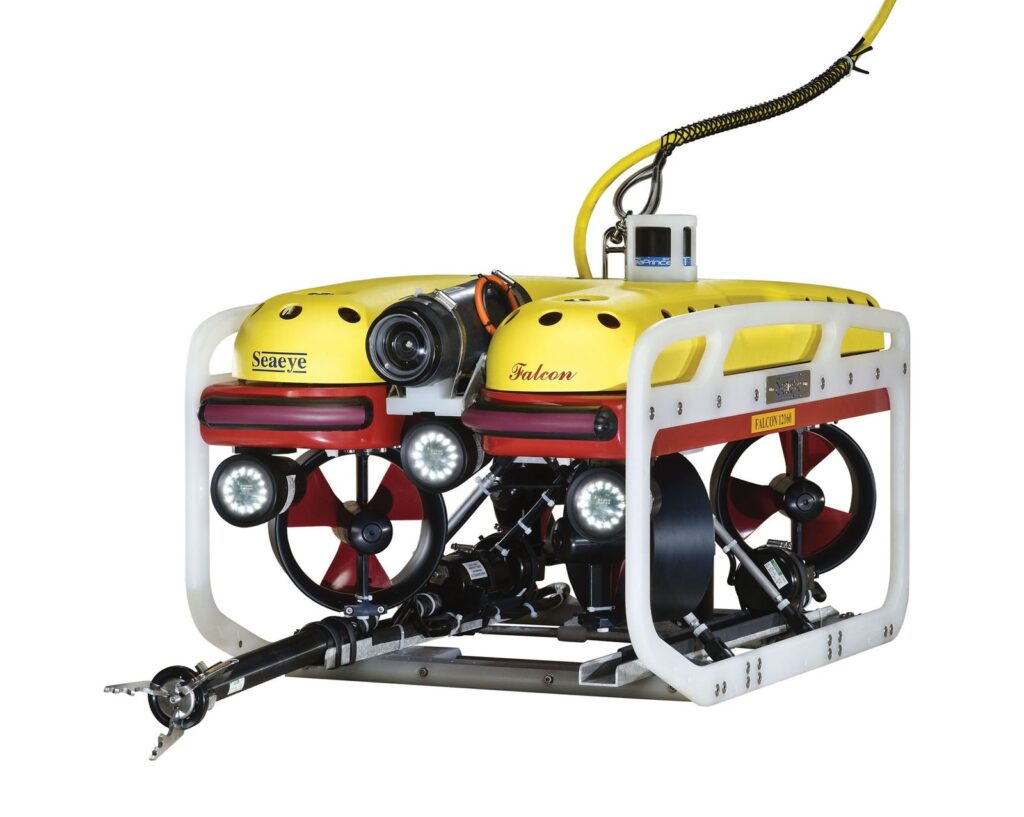
Photos: Saab Seaeye (saabseaeye.com). Shown to identify the model; a unit for sale may differ.
Looking for a Falcon?
Tell us what you need. We reply personally.
Selling a Falcon?
Free valuation. Nothing is published without your approval.
Confidential. You get an email copy of your request.
Used Saab Seaeye Falcon inspection ROVs, listed with the owner's mandate. Compare the units side by side; each listing states what its package includes. Pricing is shared after a case-use fit check.
Typical used priceAbout USD 60,000 to 90,000How we know →
Showing 1 Falcon
Available
MR-102
Inspection Class · Saab Seaeye
2011, unused, original crates
OVERVIEW
The Falcon is Saab Seaeye's compact electric inspection ROV and one of the most widely used professional vehicles of its size. It is small enough to launch by hand or with a light davit from a workboat, yet it carries a professional package: cameras, LED lights, scanning or imaging sonar, cathodic protection (CP) probes and a small manipulator.
Ship hull and port inspection, offshore platform and pipeline surveys, CP readings, aquaculture moorings, dams, intakes and outfalls, and scientific work. For deeper work or heavier tooling, buyers look at the Falcon DR, the larger Saab Seaeye vehicles or a light work-class system (see Saab Seaeye ROVs and inspection-class ROVs).
Two Falcons can be very different buys. The generation of the control system, the tether length actually supplied, the sensors and tools fitted and the spares package change the value more than the year alone. Compare the units above line by line, then ask us for the technical file of the one that fits your job.
SPECIFICATIONS
Manufacturer figures, what a used package usually includes, and the options buyers look for.
| Depth rating | 300 m (Falcon DR: 1,000 m) |
|---|---|
| Length × width × height | 1,000 × 600 × 500 mm (Falcon DR: 1,055 × 600 × 555 mm) |
| Weight in air | 60 kg (Falcon DR: 100 kg) |
| Payload | 14 kg (Falcon DR: 15 kg) |
| Forward speed | More than 3 knots |
| Thrusters | 5 (4 vectored horizontal, 1 vertical), magnetically coupled |
|---|---|
| Power input | Single-phase 110/230 V AC, 50/60 Hz |
| Lights | 2 LED lights as standard |
| Tooling options | Electric 3-jaw manipulator with rope cutter; skids for task tooling |
Saab Seaeye Falcon data sheet (rev. 19.3) and Falcon DR product page. A used unit's fitted equipment can differ; each listing states what is supplied.
What can be fitted to the Falcon, what each adds and how much it adds to a used system's value.
| Option | What it adds | New price | Adds to used value |
|---|---|---|---|
| Scanning or imaging sonarSonar | Finds structures and targets in poor visibility; most inspection contracts expect it. | Quoted | High |
| Multibeam imaging sonarSonar | A live picture of the scene in murky water; faster searches and hull work. | Quoted | High |
| Acoustic tracking (USBL) with beaconPositioning | The vehicle's position on the chart, needed for survey and for reporting where anomalies are. | Quoted | High |
| Doppler velocity log (DVL)Navigation | Station keeping and accurate dead reckoning near the seabed or a hull. | Quoted | Medium |
| CP probe (contact or proximity)Integrity | Cathodic protection readings on platforms, pipelines and hulls. | Quoted | Medium |
| Ultrasonic thickness gaugeIntegrity | Steel thickness readings for class and integrity surveys. | Quoted | Medium |
| Manipulator skidTooling | A five-function arm for recovery and light tasks (Saab lists 10 kg at full reach for the Falcon skid). | Quoted | Medium |
| Cutters (mini cutter, Gripstick)Tooling | Cuts wire rope or rope fouling a propeller or structure. | Quoted | Low |
| HD camera and laser scalingCamera | Sharper video and measurements on screen for reports. | Quoted | Medium |
| Electric winch or hand spoolLaunch | Faster, safer tether handling; the Mk6 and Mk8 winches suit free-swimming work. | Quoted | Medium |
New prices are published list or retail prices in USD, with the source and month under each price; "Quoted" means the maker or dealer publishes no price. "Adds to used value" is how strongly buyers pay for it when it comes with a used system, working and with its software.
OPERATING
Vessel, deck space, crew, power and launch: plan these before you buy.
The surface unit is a 19-inch rack in a transportable case with a fold-out monitor, so the Falcon can work from a vehicle, a quayside or a small deck without a control container.
USE CASES
Pick a job: how it runs, what you get and the typical setup. And where another model is the better buy.
The Falcon launches by hand or from a light davit, so it works from a quay, a pontoon or a small workboat. Five thrusters hold it steady against the hull, pile or berth face while the camera records.
Port authorities, ship owners and surveyors use it for hull, sea chest, propeller and berth checks without putting divers in the water for every look.
Watch out Check the current: the Falcon is rated to about 1.5 knots.
A small, light vehicle that still carries cameras, sonar and a CP probe makes the Falcon a common choice for general visual inspection and cathodic protection readings on platforms, jackets and short pipeline runs within 300 m.
Watch out For deeper water or heavier tooling, see the Tiger or Cougar XT.
Fish farms use the Falcon to inspect nets, moorings and anchors between diver visits. It is small enough to handle from a feed barge or service boat and can carry a manipulator for light tasks.
For hydro and water utilities, the Falcon inspects intakes, trash racks, gates and outfalls. Its single-phase power means it runs from a small generator on site.
PRICE GUIDE
What used Falcons sell for, the published prices behind it, what moves the price and what it costs to own one.
Asking prices, price ideas and retail prices published for this model. An asking price is not a sale price; the setup explains most of the spread.
| When | Type | Price | What was included | Source |
|---|---|---|---|---|
| Seen Nov 2026 | Guide price | About USD 65,000 (GBP 50,000) | Standard Falcon systemUK | DMC Saleyard |
| Seen Nov 2026 | Asking | About USD 89,000 (GBP 68,750) | Standard Falcon systemUK | DMC Saleyard |
| Seen Nov 2026 | Asking | USD 80,000 | 150 m vehicle with sonar and about 200 m of tetherUAE | DMC Saleyard |
All options and accessories, with sources →
Beyond the purchase price: what to budget for, how often, and how each item affects the value when you sell.
| Item | How often | What it covers | Effect on resale |
|---|---|---|---|
| One-off | |||
| Freight, duties and taxes | On purchase | Shipping the cases, import duties and taxes for your country. | None. |
| Pilot training | On purchase | Manufacturer or dealer training for new pilots. | Trained, certified pilots make a resale easier to demonstrate. |
| Acceptance test | On delivery | Power-on and wet test after shipping, with the checklist on this page. | A recorded acceptance test becomes part of the history. |
| Every year | |||
| Service | Yearly, or by hours | Seals, thrusters, connectors and electronics, by the maker or a specialist. | Service records raise the price; missing records lower it. |
| Insurance | Yearly | The vehicle, third-party liability and loss of the vehicle on a job. | None. |
| Software and licences | As released | Control software and option licences (sonar, positioning). | Transferable licences add value; locked ones lower it. |
| Per job | |||
| Crew | Every job | Pilot and tether handler; more people for long days. | None. |
| Boat and power | Every job | A workboat or quay, and a generator if there is no shore power. | None. |
| When needed | |||
| Tether repair or replacement | After damage | Re-termination or a new tether. | A tether shorter than stated lowers the price. |
| Thruster repair | After wear or damage | Seals, bearings or a replacement thruster. | Spare thrusters with the sale add value. |
No published figures for these items; we quote current costs on request.
Based on published guide and asking prices for used standard Falcon systems: GBP 50,000 and GBP 68,750 (UK) and USD 80,000 (UAE, 150 m vehicle with sonar and about 200 m of tether), seen on DMC Saleyard. GBP converted to USD. Reviewed November 2026. Indicative only, not an offer or valuation. ROV prices by class and model →
DUE DILIGENCE
Print it for the inspection. We run these checks with you before you commit.
ALTERNATIVES
The successor and the similar models buyers compare it with, side by side.
| This modelSaab Seaeye Falcon | Saab Seaeye Falcon-DR | Blue Robotics BlueROV2 | VideoRay Mission Specialist Defender | |
|---|---|---|---|---|
| Class | Inspection-Class | Inspection-Class | Inspection-Class | Inspection-Class |
| Production | In production | In production | In production | In production |
| Depth | 300 m | 1,000 m | 100–300 m | 300 m |
| Weight | 60 kg | 100 kg | 11 kg | 17.2 kg |
| Payload | 14 kg | 15 kg | — | — |
| Thrusters | — | — | 6–8 | — |
| Lift | — | — | — | 9.5 kg |
| For sale on myROVs | 1 for sale | On request | On request | On request |
| Model guide → | Model guide → | Model guide → |
Manufacturer figures for the standard models. All ROV models →
SELLING
Buyers searching for a Falcon land on this page. We value it, list it with your written mandate, check every buyer, and buyers pay a refundable deposit into escrow before they learn who you are.
Typical used priceAbout USD 60,000 to 90,000
The standard Falcon is rated to 300 m and the Falcon DR to 1,000 m. A used unit's tether may be shorter than its depth rating, so each listing states the tether supplied.
The package: the control system generation, the tether, the sensors and tools, and the spares. The side-by-side table on this page shows what each seller has declared.
Each listing states its inspection terms. Where the owner allows it, we arrange a power-on demonstration or a wet test by appointment.
Saab Seaeye specifies a single-phase 110/230 V AC supply at 50/60 Hz. We confirm the actual input rating of the unit you choose before you buy.
Two units of the same model can differ widely once package, hours and condition are counted. Tell us the job; once we confirm the unit fits it, we send the price with the full technical file.
On larger deals, payment goes through a neutral escrow service and is released when the agreed conditions are met.
Yes. Falcons often change hands off-market. Send your requirement and we search owners for you.
Yes. Most units are sold ex-works from where they are stored. We can coordinate freight, insurance and export paperwork with your forwarder; transport is quoted separately.